How to Cut Parchment Paper for Cake Pan in 7 Easy Steps
To cut parchment paper for your cake pan, it’s essential to measure your pan’s bottom and sides accurately. Properly cutting parchment paper ensures your cake releases easily and bakes evenly without sticking.
Whether you’re working with round, square, or rectangular pans, mastering this simple skill can improve your baking results.
For round pans, fold the parchment into quarters, trim the curved edge to match your pan’s radius, then unfold and fit it inside.
For square or rectangular pans, trace and cut the bottom shape, then cut strips for the sides.
Lightly grease the pan to keep parchment secure while baking, and use sharp scissors for clean edges.
Keep these tips in mind, and you’ll be ready to explore more baking hacks. Accurate cutting of parchment paper is a small step that makes a big difference in cake baking.
Happy baking!
Key Takeaways
- Measure your cake pan’s bottom and sides accurately with a ruler to ensure precise parchment paper cuts.
- For round pans, fold parchment into quarters and trim the curved edge to match the pan’s radius.
- For square or rectangular pans, trace the pan’s bottom on parchment and cut strips for lining the sides.
- Lightly grease the pan before placing parchment and secure edges with binder clips or by folding.
- Use sharp scissors and double-check measurements to avoid uneven cuts and ensure easy cake release.
Measure Your Cake Pan for Perfect Parchment Paper Fit
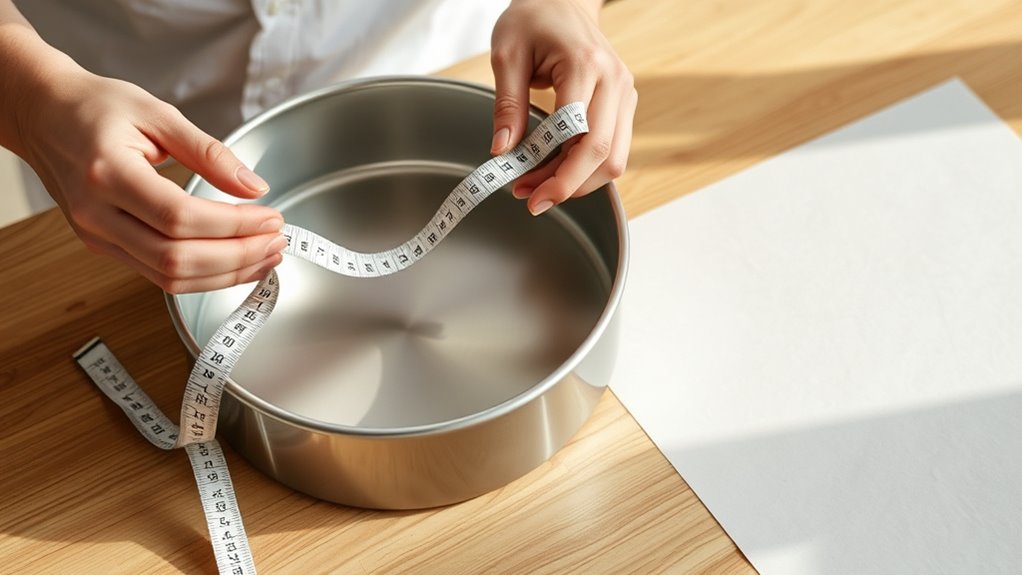
Before you cut your parchment paper, make sure you measure your cake pan accurately. Use a ruler or measuring tape to get the exact length and width of the bottom surface. Don’t forget to measure the height of the pan’s sides if you want to line them for easier cake release.
Write down these dimensions to avoid mistakes. Remember, a snug fit prevents paper from slipping during baking. If your pan is rectangular or square, measure both length and width carefully.
For irregular shapes, focus on the widest points. Double-check your measurements before cutting to save time and prevent waste. Taking this simple step guarantees your parchment paper fits perfectly, protecting your cake and pan without excess paper bunching up or leaving gaps.
Cut Parchment Paper for Round Cake Pans (Using the Folding Method)
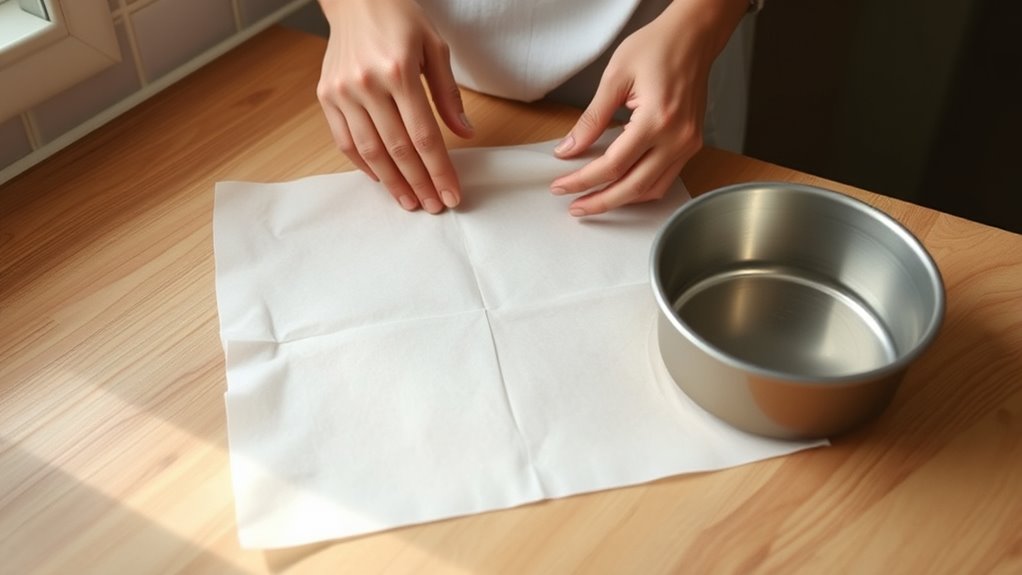
When you’re ready to cut parchment paper for a round cake pan, the folding method offers a quick and accurate way to create a perfect circle. Start by tearing off a sheet larger than your pan. Fold it in half, then fold it in half again to form a quarter circle.
Hold the folded edge steady and use scissors to trim the curved edge so it matches the radius of your pan. To check the size, unfold the paper and place it inside the pan. If it’s too big, refold and trim a bit more.
Once it fits snugly, lay the parchment in the pan, pressing it flat. This method saves time and guarantees your cake won’t stick to the pan’s bottom.
Cut Parchment Paper for Square & Rectangular Pans
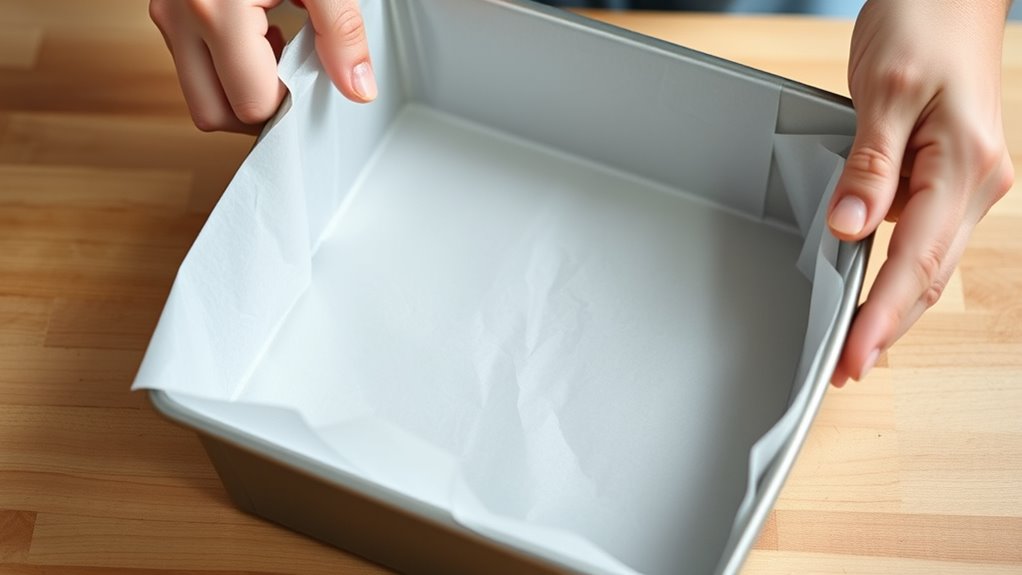
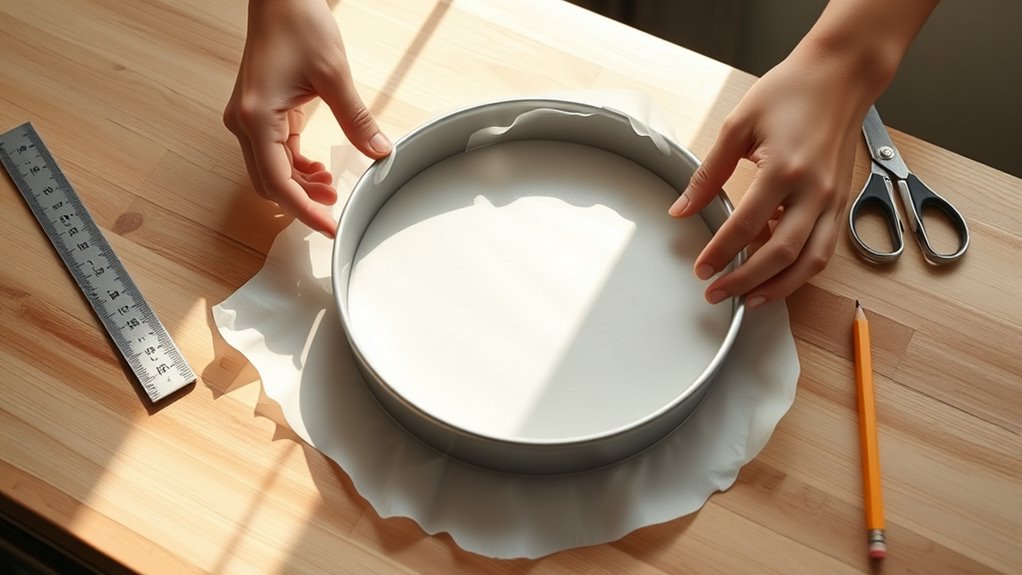
Cutting parchment paper for square and rectangular pans is straightforward compared to round pans. Simply place your pan on the parchment sheet and use a pencil to trace around the bottom. Then, cut along the line with scissors.
Cut parchment paper easily by tracing your square or rectangular pan’s bottom and cutting along the line.
This method ensures a perfect fit without any excess paper bunching up during baking.
If you want to line the sides as well, measure the height of the pan and cut strips of parchment that match the pan’s perimeter and height. Press these strips against the pan’s sides, overlapping the corners slightly to create a neat lining. This approach helps your cake release easily and keeps the pan clean.
With these simple steps, you’ll have perfectly cut parchment paper ready for any square or rectangular pan.
Tips to Keep Parchment Paper Secure in Your Cake Pan
Although parchment paper is essential for easy cake release, it can sometimes shift or wrinkle during baking. To keep it secure, first, lightly grease your pan before placing the parchment; this helps it stick better. You can also cut your parchment slightly larger than the pan, letting the edges rise to hold the paper in place.
Another trick is to use binder clips on the pan’s edges before pouring the batter—just remove them before baking. If you’re lining a round pan, folding the parchment into quarters before cutting creates a perfect fit that stays put. Finally, pour the batter slowly and evenly to avoid moving the parchment around.
These tips ensure your parchment stays snug, giving you smooth cake removal every time.
Common Parchment Paper Cutting Mistakes to Avoid
You’ll want to avoid common mistakes like cutting the parchment paper too small or too big due to incorrect measurements. Don’t use dull scissors, as they can tear the paper and make uneven edges.
Also, remember to take into account your pan’s shape to ensure the paper fits perfectly.
Incorrect Measurements
When you don’t gauge your parchment paper correctly, your cake might stick to the pan or bake unevenly. If the paper is too small, it won’t cover the pan’s bottom and sides completely, causing batter to stick and making cleanup harder.
On the other hand, too large a piece can bunch up, folding under the cake and creating uneven baking surfaces. To avoid this, always measure the pan’s dimensions accurately—bottom diameter or length and width, plus a bit extra for the sides. Use a ruler or measuring tape, and mark your measurements lightly on the paper before cutting.
Taking the time to measure precisely ensures a perfect fit, helps your cake release easily, and promotes even baking every time.
Using Dull Scissors
Since dull scissors tear parchment paper instead of cutting it cleanly, they can cause jagged edges that don’t fit your pan properly. You want smooth, precise cuts to ensure the paper lies flat, preventing uneven baking or sticking. Using sharp scissors makes the process easier and your parchment looks professional.
| Problem with Dull Scissors | Solution |
|---|---|
| Jagged edges | Use sharp scissors |
| Paper tearing | Cut slowly and steadily |
| Uneven fit in pan | Trim excess after initial cut |
| Frustration and waste | Keep scissors dedicated to paper |
| Time-consuming | Regularly sharpen or replace |
Avoid dull scissors to save time and ensure your parchment fits perfectly every time.
Ignoring Pan Shape
Sharp scissors help you cut parchment paper cleanly, but even the best cut won’t fit properly if you disregard your pan’s shape. Whether your pan is round, square, or rectangular, each requires a different cutting approach. Don’t just cut a simple square or circle and expect it to line the pan perfectly.
If you overlook the pan’s dimensions and curves, your parchment may bunch up, wrinkle, or leave uncovered spots. Take time to measure or trace the pan’s bottom and sides accurately. For round pans, cut a perfect circle; for square or rectangular pans, cut strips to line the sides and a piece for the bottom.
Paying attention to your pan’s shape ensures a smooth, non-stick surface and easy cake release every time.
How to Store and Reuse Parchment Paper for Baking
Although parchment paper is designed for single use, you can often store and reuse it several times if it remains clean and intact. After baking, let the paper cool completely. If there’s no stuck-on batter or grease, gently fold the parchment and store it flat or rolled in a dry, cool place.
Avoid crumpling it, as creases can affect its performance. For lightly used sheets, you can trim off greasy or stained edges to extend usability. Keep in mind that heavily browned or brittle parchment won’t hold up well for another round.
Bonus: Quick Tricks for Perfect Parchment Paper Lining Every Time
When you want flawless results, mastering a few quick tricks can make lining your cake pans with parchment paper easier and more efficient. First, lightly grease the pan before placing the parchment to keep it in place. Second, use scissors to cut the parchment in one smooth motion for clean edges.
Third, fold the parchment into quarters to quickly find the center and cut a perfect circle.
| Trick | Benefit |
|---|---|
| Lightly grease pan | Prevents paper from slipping |
| Smooth scissors cut | Creates neat, exact edges |
| Fold parchment in quarters | Speeds up cutting circles |
| Use a template or pan lid | Ensures perfect size every time |
These tips will help you line pans quickly and perfectly every time.
Frequently Asked Questions
Can Parchment Paper Be Used for Non-Baking Purposes?
Yes, you can use parchment paper for non-baking purposes like wrapping food, lining shelves, or protecting surfaces during crafts. It’s grease-resistant and non-stick, making it handy for many household tasks beyond baking.
Is Parchment Paper Safe in the Microwave?
You might worry parchment paper will catch fire, but it’s safe in the microwave as long as it doesn’t touch the heating elements.
Just avoid metal, and you can confidently use it to cover or wrap your food.
What Is the Difference Between Parchment Paper and Wax Paper?
Parchment paper is heat-resistant and non-stick, perfect for baking, while wax paper is coated with wax, making it moisture-resistant but not heat-safe.
You shouldn’t use wax paper in the oven because it can melt or catch fire.
Can I Use Parchment Paper for Cooking at High Temperatures?
You’re in luck—parchment paper loves a hot date! It can handle high temperatures up to about 420°F (215°C).
Just don’t push it beyond that, or it might start to feel a little uncomfortable.
How Do I Prevent Parchment Paper From Sticking to Cake Batter?
You prevent parchment paper from sticking by lightly greasing it with butter or oil before pouring the batter. This creates a non-stick barrier, ensuring your cake releases easily without tearing or sticking to the paper.
Greasing the paper also helps maintain the cake’s texture and appearance. Be sure to cover the entire surface evenly for best results.
This simple step makes your baking process smoother and cleanup easier. It’s especially helpful for delicate cakes that might otherwise stick and break.
Conclusion
Just like a well-cut parchment paper frames your cake, your careful hands shape sweet success. Each fold and trim is a step toward a masterpiece, where precision meets creativity.
Remember, the paper’s gentle embrace protects and perfects, much like your patience and care in baking. Keep these steps close, and every cake you bake will rise with confidence, wrapped in the quiet magic of a perfectly lined pan.
By mastering how to cut parchment paper for cake pan, you ensure an even bake and easy release. These simple steps help your cake look professional and taste delicious every time. Happy baking!