
What Size Is a Cake Pan
You’ll find cake pans come in common sizes like 8, 9, or 10 inches round, 8×8 or 9×9 inches square, and 9×13 inches rectangular. Understanding what size is a cake pan is essential for baking success.
Depth usually ranges from 2 to 3 inches, affecting baking time and cake height.
Choosing the right size guarantees your cake bakes evenly without overflow or dryness.
Knowing how to measure and adjust pans helps you get perfect results every time. Keep exploring to master your baking with the ideal pan size.
Key Takeaways
- Common cake pan sizes include 8, 9, and 10 inches for round pans, 8×8 and 9×9 inches for square pans, and 9×13 inches for rectangular pans.
- Pan depth usually ranges from 2 to 3 inches, affecting baking time and cake thickness.
- Specialty pans like Bundt, loaf, and mini springform vary in size for specific cake types and shapes.
- Proper pan size ensures even baking, correct cake texture, and prevents overflow or dryness.
- Measure pan volume (length × width × depth or π × radius² × depth) to adjust batter and baking times accurately.
Why Cake Pan Size Matters for Baking Success

Although it might seem like a small detail, choosing the right cake pan size directly affects how your cake bakes. If your pan is too small, the batter will overflow, creating a mess and uneven baking. Too large a pan spreads the batter too thin, leading to a dry, overcooked cake.
The pan size also influences baking time—smaller pans generally require longer baking, while larger pans need less time. Using the correct pan guarantees your cake rises properly and cooks evenly, preventing underbaked centers or burnt edges. When you follow the recipe’s recommended pan size, you get the texture and shape the baker intended.
Most Common Cake Pan Sizes Explained
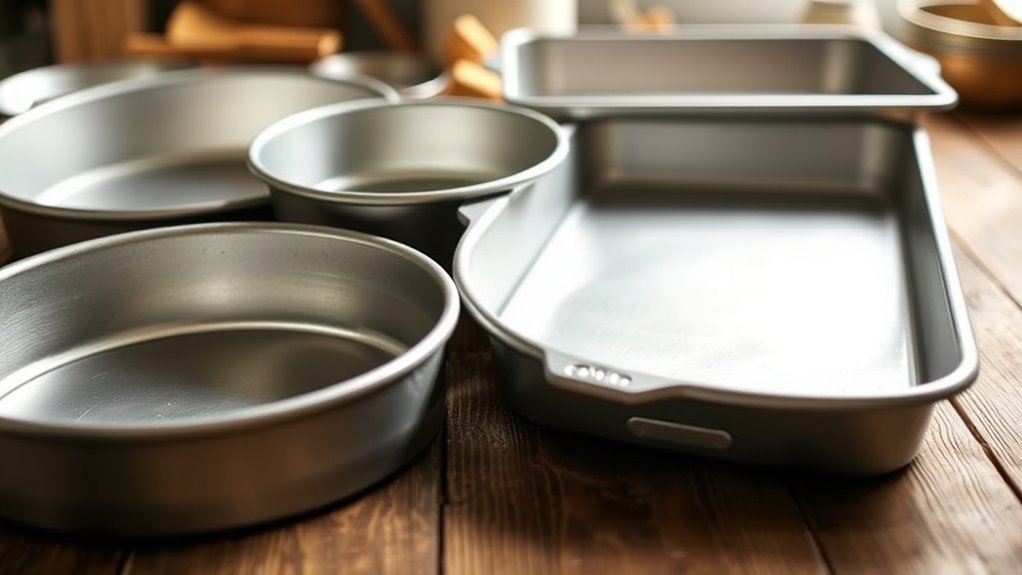
You’ll find that standard cake pans come in a few common sizes, like 8, 9, and 10 inches in diameter for round pans. Square and rectangular pans also have typical dimensions that affect baking time and batter quantity.
Understanding these shapes and sizes helps you pick the right pan for your recipe every time.
Standard Cake Pan Dimensions
When choosing a cake pan, understanding the standard dimensions can make your baking process smoother and more predictable. Most cake pans come in a few common sizes: 8 inches, 9 inches, and 10 inches in diameter for round pans, and 8×8 inches or 9×13 inches for square and rectangular pans. These measurements refer to the top diameter or length and width, not the base.
Depth usually ranges between 2 to 3 inches, affecting cake thickness and baking time. Knowing these dimensions helps you adjust batter quantities and oven settings efficiently. If a recipe calls for a specific pan size, using one with similar dimensions ensures consistent results without undercooked or overly dense cakes.
Stick to these standards to bake with confidence every time.
Pan Shapes And Sizes
Understanding standard cake pan dimensions sets a solid foundation, but knowing the variety of pan shapes and sizes available can help you choose the perfect one for your recipe. Round pans, typically 8 or 9 inches in diameter, are great for layered cakes. Square pans, often 8 or 9 inches, work well for brownies or bars.
Rectangular pans, like the 9×13 inch, suit sheet cakes and large batches. If you want something fun, consider specialty shapes like heart or bundt pans, which add personality to your dessert. Keep in mind, the pan’s depth affects baking time and cake texture.
How to Measure Your Cake Pan Correctly

To measure your cake pan correctly, start by checking its length, width, and depth using a ruler or tape measure. Once you have these dimensions, you can calculate the pan’s volume to understand how much batter it will hold. This step helps you adjust recipes and avoid overflows or underfilled cakes.
Measuring Pan Dimensions
Measuring your cake pan accurately starts with knowing which dimensions matter most: the diameter or length and width, along with the depth. For round pans, measure straight across the top from one edge to the other to get the diameter. For square or rectangular pans, measure the length and width from the inner edges, not the outer rim.
Always measure inside the pan to guarantee you’re capturing the actual baking space. Depth is just as important—use a ruler to measure from the bottom to the top edge inside the pan. Avoid including any flared rims or handles in your measurements.
Taking these precise dimensions helps you understand your pan’s size better and ensures your recipes turn out as expected.
Calculating Pan Volume
Once you have your pan’s exact dimensions, you can calculate its volume to determine how much batter it can hold. For rectangular or square pans, multiply length by width by depth (height) to get cubic inches. For circular pans, use the formula π × radius² × depth.
Remember, the radius is half the diameter. If you’re working with a springform or specialty pan, break it down into simpler shapes or refer to manufacturer specs. Knowing your pan’s volume helps you adjust recipes accurately, preventing overflow or underfilled layers.
You can convert cubic inches to cups by dividing by 14.44, since one cup equals about 14.44 cubic inches. This step guarantees your batter matches the pan size, leading to perfectly baked cakes every time.
How to Choose the Right Cake Pan Size for Your Recipe
Although choosing the right cake pan size might seem straightforward, it can profoundly impact your baking results. You want your cake to bake evenly without overflowing or turning out dry. Start by checking your recipe’s specified pan size.
If it’s listed, use that size to guarantee the best outcome. When it’s not, match the pan’s volume to the amount of batter you have. Remember, a pan that’s too small will cause batter to spill, while a larger one may result in a thinner, faster-baking cake.
Also, consider the pan’s shape—round, square, or rectangular—as it affects baking time and texture. By selecting the proper size, you’ll achieve the right cake height, texture, and doneness without guesswork.
How to Adjust Recipes for Different Cake Pan Sizes
When you switch to a different cake pan size, you’ll need to adjust your recipe to guarantee the batter fills the pan properly and bakes evenly. First, calculate the volume of your original pan and the new one to compare sizes. Use the formula for each pan’s volume—area times depth for rectangular pans, or πr²h for round ones.
Then, multiply your ingredient amounts by the ratio of the new pan’s volume to the original. For example, if the new pan holds 25% more batter, increase ingredients by 25%. Keep an eye on baking time, as larger pans usually require longer baking, while smaller pans bake faster.
Adjust temperature slightly if needed, but mostly monitor doneness with a toothpick test.
Converting Cake Pan Sizes Without Ruining Your Cake
Adjusting recipes for different cake pan sizes is just the start of making sure your cake turns out perfectly. When converting pan sizes, focus on the volume the batter will fill. Calculate the pan’s volume (length × width × height for rectangular, or π × radius² × height for round pans) and adjust your batter accordingly.
If the new pan is larger, increase your ingredients proportionally; if smaller, reduce them. Keep an eye on baking time—larger pans often need longer, smaller ones less. Avoid overfilling pans to prevent spills.
Use an oven thermometer and test for doneness with a toothpick. By understanding these key elements, you’ll confidently convert cake pan sizes without compromising texture or rise, ensuring your cake bakes evenly and tastes just right every time.
Why Cake Pan Depth Matters: Shallow vs. Deep Pans
Because the depth of your cake pan directly affects how your cake bakes, it’s important to select the right one for your recipe. Shallow pans, usually 1 to 2 inches deep, bake cakes faster and create a thinner, more even layer. They’re great when you want multiple layers or a quicker bake time.
Deep pans, often 3 inches or more, hold more batter and produce taller cakes, but they take longer to bake through. If you use a deep pan, you’ll need to adjust baking times and temperatures to avoid undercooked centers or overbrowned edges. Also, deep pans may require you to test doneness more carefully.
Choosing the proper pan depth guarantees your cake bakes evenly and achieves the texture you want.
How Round, Square, and Rectangular Cake Pan Sizes Affect Baking
Although all cake pans might seem similar, the shape and size you choose considerably impact how your cake bakes. Round pans promote even heat distribution, making them perfect for layered cakes. Square pans have sharp corners, which can cause edges to bake faster than the center.
Choosing the right cake pan shape and size greatly affects baking results and even heat distribution.
Rectangular pans offer more surface area, ideal for sheet cakes or bars, but may require longer baking times. When selecting a pan, consider how the shape affects baking time and texture:
- Round pans provide uniform rise and browning
- Square pans create defined edges, good for frosting
- Rectangular pans hold more batter, needing adjusted bake times
- Smaller pans yield thicker cakes; larger pans spread batter thin
- Pan material also works with shape to influence heat conduction
Knowing this helps you bake perfectly every time.
Specialty Cake Pans: Sizes and How to Use Them
When you use specialty cake pans, knowing their common sizes helps you adjust recipes accurately. These pans often come in fun shapes like hearts or stars, but their volume can differ from standard pans.
Keep a few tips in mind to make certain your cake bakes evenly and turns out just right.
Common Specialty Pan Sizes
Specialty cake pans come in a variety of unique shapes and sizes that let you get creative with your baking. Knowing the common sizes helps you pick the right pan for your recipe and guarantees proper baking times.
Here are some popular specialty pans you might encounter:
- Bundt pans – typically 10-inch diameter, holding about 10-12 cups of batter
- Loaf pans – usually 8.5 x 4.5 inches or 9 x 5 inches, perfect for bread or pound cake
- Tube pans – commonly 9 or 10 inches in diameter, great for angel food cakes
- Heart-shaped pans – often 8 or 9 inches, ideal for themed occasions
- Mini springform pans – around 4 inches, perfect for personal-sized cheesecakes
Choosing the right size specialty pan helps your cake bake evenly and look stunning.
Tips For Using Specialty Pans
How can you guarantee your creative cake shapes bake perfectly every time? First, always grease and flour specialty pans thoroughly to prevent sticking. Since these pans often have unique shapes, rotate them halfway through baking for even heat distribution.
Use an oven thermometer to ascertain the temperature is accurate, and consider reducing baking time slightly, checking doneness early. When cooling, let the cake rest in the pan to firm up before removing it carefully.
| Tip | Reason |
|---|---|
| Grease & flour well | Prevents sticking in intricate shapes |
| Rotate during baking | Ensures even cooking |
| Use oven thermometer | Ascertain the temperature is accurate, and consider reducing baking time slightly, checking doneness early. |
| Check early | Prevents drying out |
| Cool before removing | Helps cake hold shape |
Where to Buy the Best Cake Pans
If you want to bake consistently great cakes, choosing where to buy your cake pans matters a lot. Quality pans guarantee even baking and durability, so consider trusted sources that offer reliable products. You don’t have to settle for generic options; look for retailers known for their bakeware selection and customer satisfaction.
Here are five great places to find the best cake pans:
- Specialty kitchen stores like Williams Sonoma or Sur La Table
- Online marketplaces such as Amazon with verified reviews
- Department stores with dedicated kitchen sections like Macy’s
- Local baking supply shops where you can get hands-on advice
- Brands’ official websites for warranties and guaranteed authenticity
Choosing wisely helps you bake with confidence every time.
Frequently Asked Questions
How Do I Properly Clean and Maintain My Cake Pans?
You should wash your cake pans with warm, soapy water right after use. Avoid abrasive scrubbers to protect the surface.
Dry them thoroughly and store in a dry place to prevent rust and maintain their quality.
Can I Use Silicone Cake Pans Instead of Metal Ones?
You can definitely use silicone cake pans instead of metal ones—they’re like flexible clouds, easy to pop cakes out of.
Just remember, they heat differently, so watch your baking time and temperature closely for perfect results.
What Materials Are Best for Non-Stick Cake Pans?
You’ll want non-stick cake pans made from aluminized steel or heavy-gauge aluminum with a non-stick coating. These materials heat evenly and release cakes easily, helping you avoid sticking and achieve perfect, smooth results every time.
How Do Cake Pan Sizes Affect Baking Time?
When it comes to baking time, bigger cake pans mean thinner batter, so your cake cooks faster. Smaller pans take longer since the batter’s thicker. You’ll want to keep an eye on it, no two ways about it.
Are There Eco-Friendly Options for Cake Pans?
Yes, you’ll find eco-friendly cake pans made from recycled aluminum, silicone, or bamboo fiber. These options reduce environmental impact and often last long.
Just make sure they’re durable and safe for your oven use.
Conclusion
You might think any cake pan will do, but choosing the right size truly makes a difference in your baking success. When you pick the correct pan, your cake bakes evenly, looks great, and tastes better. Don’t worry if you only have one size—adjusting your recipe is simpler than you think.
Taking the time to match your pan size to your recipe guarantees delicious results every time, making your baking experience smooth and satisfying. Understanding what size is a cake pan can help you achieve the perfect texture and appearance for your cakes. Always remember, the right cake pan size is key to baking success.