
How Long to Cook Pizza in Oven
You should cook your pizza at 475°F to 500°F for 10 to 15 minutes to get a crispy crust and melted cheese. Cooking pizza in the oven at the right temperature is essential for achieving that perfect balance of a golden crust and gooey toppings.
Thin crusts take less time, around 8 to 12 minutes, while thick or stuffed crusts need 15 to 25 minutes.
Using a preheated pizza stone or steel can speed up cooking and improve texture. Adjust timing for your toppings and oven type to avoid sogginess or burning.
Learn how to perfect every detail for your ideal pizza.
Key Takeaways
- Bake pizza at 475°F to 500°F for 10-15 minutes for a crispy crust and melted cheese. Thin crust pizzas cook faster, typically in 8-12 minutes at higher temperatures.
- Thick or stuffed crust pizzas require longer baking, around 15-25 minutes at 375°F to 425°F. Use a preheated pizza stone or steel to reduce cooking time and enhance crust crispiness.
- Adjust baking time based on toppings, oven type, and visual cues like golden crust and bubbling cheese.
How Long to Cook Fresh Homemade Pizza
When you make fresh homemade pizza, you’ll want to bake it at a high temperature—typically between 475°F and 500°F—to get a crispy crust and melted cheese. Generally, your pizza will need about 10 to 15 minutes in the oven. Keep an eye on it starting around the 10-minute mark, as ovens can vary.
You’ll know it’s done when the crust turns golden brown and the cheese is bubbly and slightly browned. If you’re using fresh toppings with high moisture, you might want to bake a little longer to avoid a soggy crust. Placing your pizza on a preheated pizza stone or steel can also speed up cooking and improve texture.
Just remember, exact timing depends on your oven and pizza thickness.
Baking Times for Thin Crust vs. Thick Crust Pizza
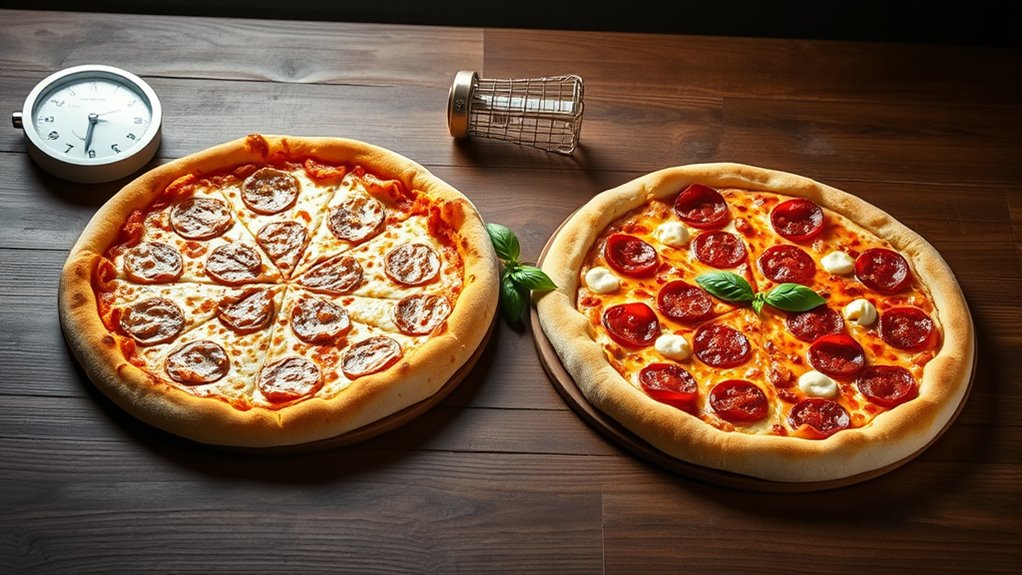
When baking thin crust pizza, you’ll want a shorter cooking time at a higher temperature to keep it crispy. Thick crust pizza needs more time in the oven at a slightly lower heat to cook through evenly.
Understanding these differences guarantees your pizza turns out just right every time.
Thin Crust Cooking Time
Thin crust pizzas typically bake faster than their thick crust counterparts, usually taking around 8 to 12 minutes in a preheated oven at 475°F (245°C). Because the dough is thinner, heat penetrates quickly, crisping the crust and melting the toppings evenly without drying them out. You’ll want to keep a close eye on your pizza to avoid burning, as the thin base cooks rapidly.
For the best results, place your pizza directly on a preheated pizza stone or baking steel to ensure a crisp bottom. If you use a baking sheet, it may take a minute or two longer. Once the cheese bubbles and the crust turns golden brown, your thin crust pizza is ready to enjoy—quick, simple, and delicious every time.
Thick Crust Baking Duration
While thin crust pizzas cook quickly due to their slender base, thick crust varieties require more time to achieve that perfect balance of a fully baked interior and a golden, crispy exterior.
You’ll need to allow extra minutes in the oven to guarantee the dough cooks through without burning the toppings. Here’s a quick comparison to guide you:
| Pizza Type | Baking Time (minutes) | Notes |
|---|---|---|
| Thin Crust | 7-10 | Cooks fast, crisp edges |
| Thick Crust | 15-20 | Needs longer for fluffy dough |
| Stuffed Crust | 18-22 | Extra time for filling |
| Deep Dish | 20-25 | Slow bake for even cooking |
| Sicilian Style | 18-22 | Thick and airy base |
Adjust timing based on your oven and toppings.
Temperature Differences Impact
Because oven temperature directly affects cooking time, you’ll need to modify how long you bake thin and thick crust pizzas to get the best results. Thin crust pizzas cook faster at higher temperatures, typically around 450-500°F, usually done within 8-12 minutes. The intense heat crisps the crust quickly without drying out the toppings.
Thick crust pizzas require lower temperatures, about 375-425°F, and longer baking times—often 15-20 minutes—to ensure the dough cooks through without burning the exterior. If you bake a thick crust pizza at too high a temperature, the outside may char while the inside stays doughy. Conversely, baking thin crust pizza too long at a lower temperature can make it soggy.
Adjusting temperature and time based on crust thickness helps you achieve perfect texture and doneness every time.
What Oven Temperature Works Best for Pizza
Choosing the right oven temperature plays a crucial role in achieving the perfect pizza crust and toppings. You’ll want to set your oven between 450°F and 500°F (230°C to 260°C) for most homemade pizzas. This range ensures your crust crisps up nicely without burning, while melting cheese evenly.
If you use a pizza stone, preheat it at the highest temperature your oven allows to replicate a traditional pizza oven’s intense heat. Avoid lower temperatures; they can make your crust soggy and undercooked. On the other hand, temperatures above 500°F risk burning toppings before the dough cooks through.
Adjust slightly depending on your oven’s performance, but sticking within this range helps you bake a balanced, delicious pizza every time.
How Your Toppings Affect Pizza Cooking Time
Your toppings play a big role in how long your pizza needs to cook. Cheese has to melt evenly, while vegetables release moisture that can affect cooking time.
Paying attention to these details helps you get the perfect bake every time.
Cheese Melting Time
While cheese typically melts quickly, the type and amount you use can notably change your pizza’s overall cooking time. For instance, fresh mozzarella has a higher moisture content and melts faster, but it can make the crust soggy if you add too much. Harder cheeses like Parmesan don’t melt as much and mainly add flavor, so they won’t substantially affect cooking time.
If you pile on a thick layer of cheese, it’ll need more heat and time to fully melt and bubble, which might extend baking by a few minutes. On the other hand, a thin layer melts quickly, speeding up the process. To get the best results, balance your cheese type and quantity to guarantee even cooking without compromising crust texture.
Vegetable Moisture Impact
Cheese isn’t the only topping that affects how long your pizza takes to bake—vegetables play a big role too. Fresh vegetables like mushrooms, tomatoes, and zucchini contain high moisture, which can slow down baking by releasing water onto the dough. This extra moisture may make your crust soggy if you don’t modify cooking time or temperature.
To counteract this, you might want to pre-cook or drain watery vegetables before adding them. On the other hand, drier vegetables like bell peppers or onions won’t impact baking time as much. When you load your pizza with moist veggies, expect to add a few extra minutes to ensure everything cooks thoroughly without compromising texture.
Paying attention to vegetable moisture helps you achieve a perfectly baked pizza every time.
How to Tell When Your Pizza Is Perfectly Cooked
Even if you follow the recipe exactly, it can be tricky to know when a pizza is perfectly cooked. Look for a golden-brown crust with slightly charred spots, signaling it’s crisp without being burnt. The cheese should be bubbly and melted, with no visible pools of oil on top.
Check the crust’s bottom by lifting the pizza gently—if it’s firm and evenly browned, you’re good. Avoid relying solely on time; ovens vary in heat distribution. Also, the toppings should look cooked but not dried out.
If you notice any doughy or pale areas, give it a minute or two more. Using these visual and tactile cues will help you pull out a pizza that’s just right every time.
Cooking Frozen Pizza: Time and Temperature Tips
When cooking frozen pizza, you’ll want to set your oven to the ideal temperature for even baking, usually around 400°F to 450°F. Most frozen pizzas take about 12 to 18 minutes to cook, but keep an eye on the crust to avoid sogginess.
To get that crispy crust you love, try placing the pizza directly on the oven rack or using a preheated pizza stone.
Optimal Oven Temperature
Although frozen pizzas vary in thickness and toppings, setting your oven to the right temperature is key to achieving a crispy crust and evenly melted cheese. Generally, preheating your oven between 400°F and 450°F works best. At this range, the intense heat cooks the pizza quickly, preventing sogginess while ensuring the cheese bubbles perfectly.
Avoid lower temperatures, as they can make the crust limp and the toppings undercooked. On the other hand, extremely high temperatures above 500°F might burn the edges before the center cooks through. Always place your pizza on a middle rack or directly on the oven rack to promote even heat circulation.
Recommended Cooking Time
Since oven temperatures vary, you’ll want to keep a close eye on your frozen pizza as it cooks to avoid over- or undercooking. Generally, most frozen pizzas bake well between 12 to 18 minutes at 400°F to 425°F. Check the package instructions first—they’re usually tailored for that specific pizza.
Start checking your pizza around the 12-minute mark; look for bubbly cheese and a golden-brown crust. If the crust looks pale or the cheese isn’t fully melted, give it a few more minutes. Avoid opening the oven door too often, but a quick glance won’t hurt.
Tips for Crispy Crust
To achieve a crispy crust, you’ll want to preheat your oven thoroughly and consider using a pizza stone or baking steel to distribute heat evenly. Place the stone or steel in the oven while it preheats to around 450-500°F. When you put your frozen pizza directly on this hot surface, it helps draw out moisture and crisps the bottom.
Avoid placing the pizza on a cold baking sheet, as it can make the crust soggy. Also, try baking your pizza on the lower rack to get closer to the heat source. If your crust still feels soft, finish with a quick broil for 1-2 minutes, but watch closely to prevent burning.
These tips help you get that perfect crunch every time.
How to Reheat Leftover Pizza Without Drying It Out
When you want to enjoy leftover pizza without it turning dry and tough, reheating it properly is key. Skip the microwave, which often makes crust rubbery. Instead, preheat your oven to 375°F (190°C).
Place the pizza slices on a baking sheet and cover them loosely with foil to retain moisture. Heat for about 8-10 minutes until the cheese melts and the crust crisps up. Alternatively, use a skillet on medium heat: place the slice in, cover with a lid, and cook for 5-6 minutes.
This method crisps the bottom while melting the cheese on top without drying it out. Always check periodically to avoid overcooking. These techniques help you savor leftover pizza that tastes fresh and delicious every time.
How Pizza Stones and Steels Affect Cooking Time
Reheating pizza effectively relies on managing heat and moisture, but cooking fresh pizza from scratch brings its own challenges—especially around oven temperature and timing. Using a pizza stone or steel can greatly impact how long your pizza needs to bake. These tools absorb and retain heat, delivering a much hotter surface than a regular baking sheet.
That intense, even heat cooks the crust faster and more evenly, often reducing your cooking time by a few minutes. You’ll want to preheat your stone or steel in the oven for at least 30-45 minutes to ensure it’s thoroughly heated. Keep in mind, the thickness and material of the stone or steel also affect heat transfer, so you might need to experiment a bit to find the perfect cook time for your setup.
How to Adjust Cooking Time for Convection Ovens
Although convection ovens circulate hot air more efficiently, they typically cook pizza faster than conventional ovens, so you’ll need to reduce the cooking time or temperature to avoid overcooking. Start by lowering the oven temperature by about 25°F (14°C) compared to your usual setting. Alternatively, you can keep the temperature the same but shorten the cooking time by 20-25%.
Keep a close eye on your pizza as it cooks, since convection ovens brown toppings quickly. Check for a golden crust and bubbly cheese a few minutes earlier than you normally would. If you’re using a pizza stone or steel, remember they also speed up cooking, so factor that in when adjusting time.
With these tweaks, you’ll get perfectly cooked pizza every time in your convection oven.
Common Pizza Cooking Mistakes to Avoid
If you want your pizza to come out perfect every time, you need to avoid some common cooking mistakes. These errors can ruin your pizza’s texture and flavor, no matter how good your recipe is. Here are key pitfalls to watch out for:
- Overloading toppings: Too many toppings release excess moisture, leading to a soggy crust.
- Incorrect oven temperature: Cooking at too low or too high a temperature affects both crust doneness and cheese melting.
- Not preheating the oven: Skipping this step prevents the pizza from cooking evenly, leaving some parts undercooked.
Quick Tips for a Crispy Pizza Crust Every Time
Avoiding common mistakes like overloading toppings and improper oven settings sets the stage for a great pizza, but achieving a crispy crust takes a few more focused steps. Start by preheating your oven to its highest temperature, ideally 475-500°F, to mimic professional pizza ovens. Use a pizza stone or steel to evenly distribute heat and absorb moisture from the dough.
Roll your dough thin and avoid excess sauce, which can make the crust soggy. Brush the edges lightly with olive oil to enhance browning and crispness. Bake directly on the hot surface rather than a baking sheet for better heat transfer.
Finally, keep an eye on your pizza, rotating it halfway through cooking to ensure even crisping. These simple tips will help you get a perfectly crispy crust every time.
Frequently Asked Questions
Can I Cook Pizza in a Microwave Instead of an Oven?
You can cook pizza in a microwave, but it won’t get crispy like in an oven. You’ll get a softer crust and uneven heating, so it’s best for reheating rather than baking fresh pizza from scratch.
What Is the Best Type of Flour for Homemade Pizza Dough?
You’ll want to use bread flour for homemade pizza dough because it’s high in protein, giving your crust that perfect chewiness. Coincidentally, this extra strength helps your dough rise better and hold toppings without sogginess.
How Do I Store Pizza Dough Before Baking?
You should store pizza dough in a lightly oiled bowl, cover it tightly with plastic wrap or a damp cloth, and refrigerate. This slows fermentation and keeps it fresh for up to 3 days before baking.
Can I Use a Grill to Cook Pizza?
Yes, you can use a grill to cook pizza. Just preheat it, place the dough directly on the grates, add toppings, and close the lid.
You’ll get a crispy crust with a smoky flavor in minutes.
What Are the Health Benefits of Homemade Pizza?
When you make pizza at home, you hold the key to health’s treasure chest—fresh ingredients, less salt, and no mystery additives.
You control every topping, turning your meal into a vibrant, nourishing masterpiece.
Conclusion
You might think cooking pizza is tricky, but it’s actually all about timing and temperature—coincidentally, just like baking a cake. Whether you’re going thin crust or thick, hotter ovens mean faster cook times.
Remember, your toppings can sneakily change things up, so keep an eye on your pie. Use a pizza stone or steel, and you’ll get that crispy crust you crave.
With these tips, your homemade pizza will always come out perfect—no surprises! Knowing how long to cook pizza in oven is key to achieving delicious results every time.